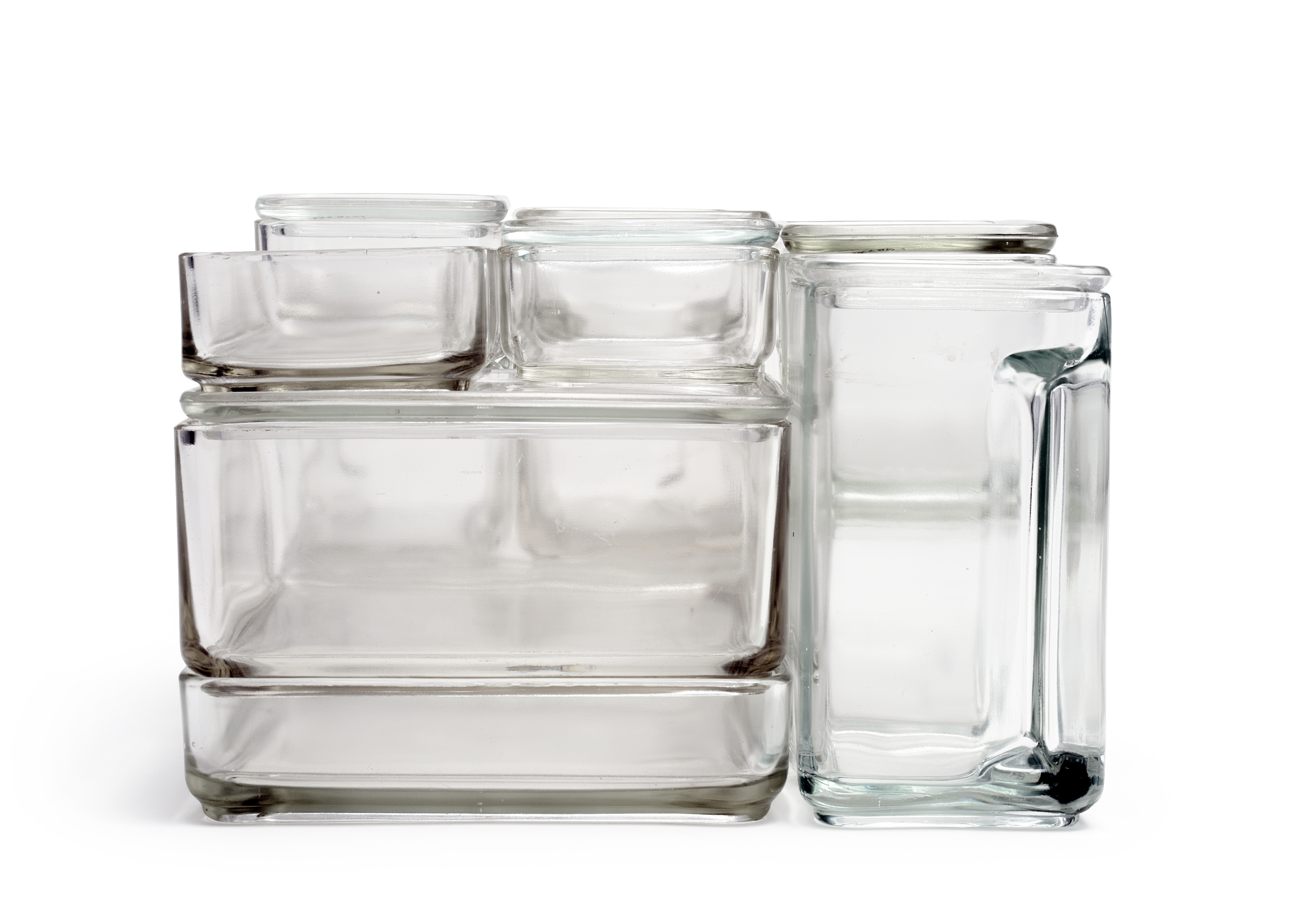
The slogan “From the pantry and refrigerator to the table” was used to advertise the KUBUS crockery designed by Wilhelm Wagenfeld in 1938. These stackable, affordable storage jars are designed to make optimum use of space in the fridge and pantry. Their simple shapes even look good on the table.
Although only a few German households had a fridge in 1938, the tableware was referred to as the “people’s fridge” — in reference to the Volksempfänger radio (“people’s receiver”) and the Volkswagen (“people’s car”). According to Wagenfeld, the design was inspired by his desire to save space in his own fridge: The square containers with handles and spouts made of pressed glass are designed as a modular system in three heights and two widths, and even ventilation slots have been included.
Wagenfeld’s aesthetic programme is characterised – in keeping with the Werkbund’s philosophy – by the pursuit of standardisation and industrial production. He rejects conventional ornamentation and decoration. During the Nazi era, he was professionally successful even though he did not join the NSDAP: in 1935, he took on the role of artistic director at Vereinigte Lausitzer Glaswerke and designed numerous patterns and series for glass products, including the KUBUS tableware. Several of his products received awards at international exhibitions, contributing to the prestige of Nazi Germany.
The Kubus crockery was advertised in the product catalogue (“Warenkunde”) published in 1939 and produced by various manufacturers until the end of the 1950s.
It can be seen until 16 March 2026 in the context of the exhibition “A suppressed chapter – The Werkbund in the context of National Socialism”.