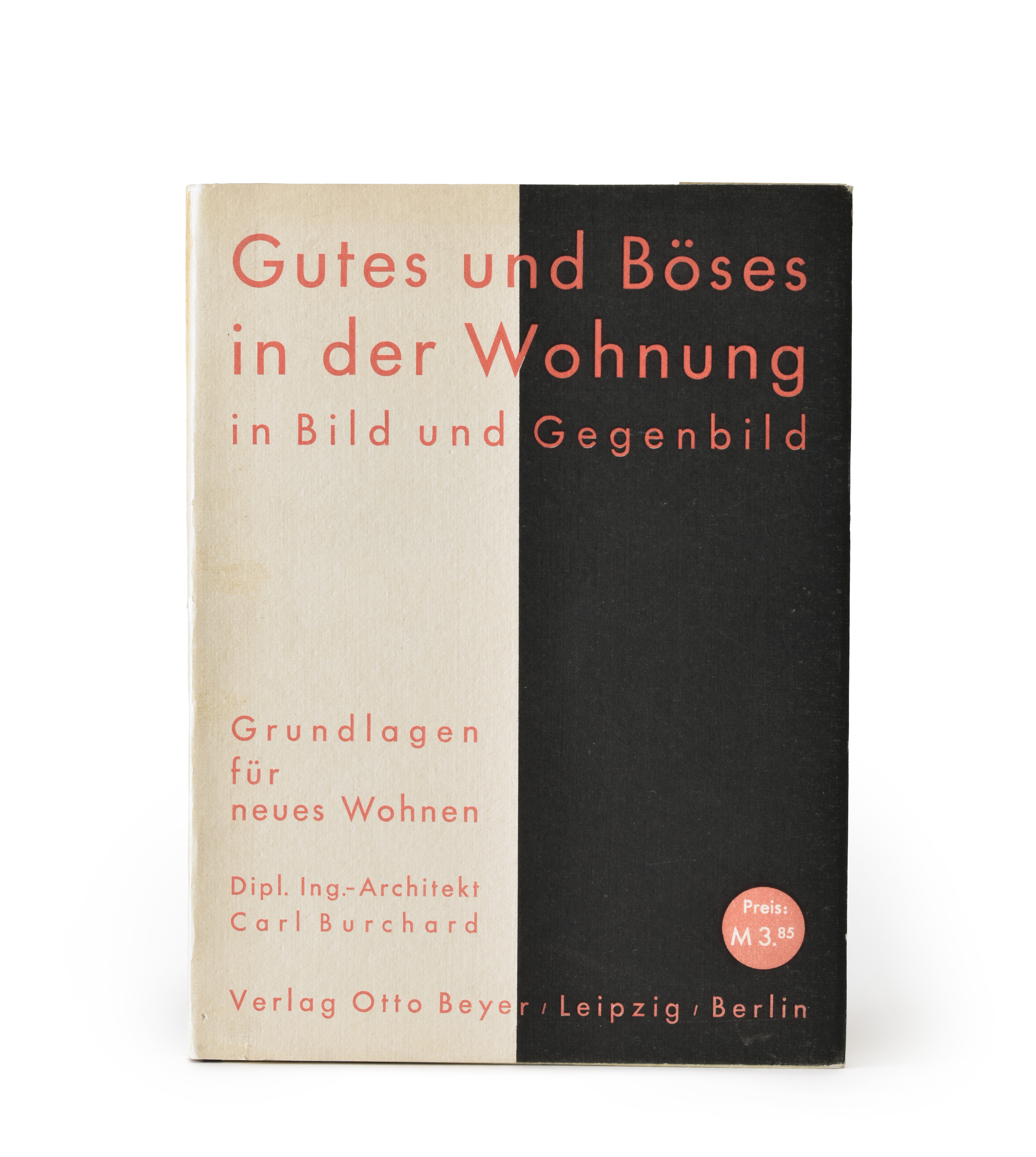
This guide to “new home living” from the Nazi era operates with a strict division between good and evil. Under the headings “Not like this” and “Like this,” negative and positive examples of furniture and household items are described and illustrated with photos.
Over-the-top, old-fashioned decor and kitsch are condemned, in favor of striving for a “domestic atmosphere of understated culture.” In some instances, a clear distaste for modernist designers is evident. Marcel Breuer’s tubular steel chair “Wassily” is described as a “seating machine” whose shape is reminiscent of an “execution chair.” However, there are also designs by Werkbund members such as Wilhelm Wagenfeld and Bauhaus students such as Marguerite Friedlaender among the positive examples.
The book shows how the absence of a clear aesthetic program in National Socialism is obscured by a supposedly unambiguous, “black-and-white” rhetoric.
This publication is on display in the “Werkbund and National Socialism” section of the permanent exhibition at the Werkbundarchiv – Museum der Dinge. Until March 16, the museum is also hosting a small exhibition entitled “A surpressed chapter – The Werkbund in the context of National Socialism” on its object stage.