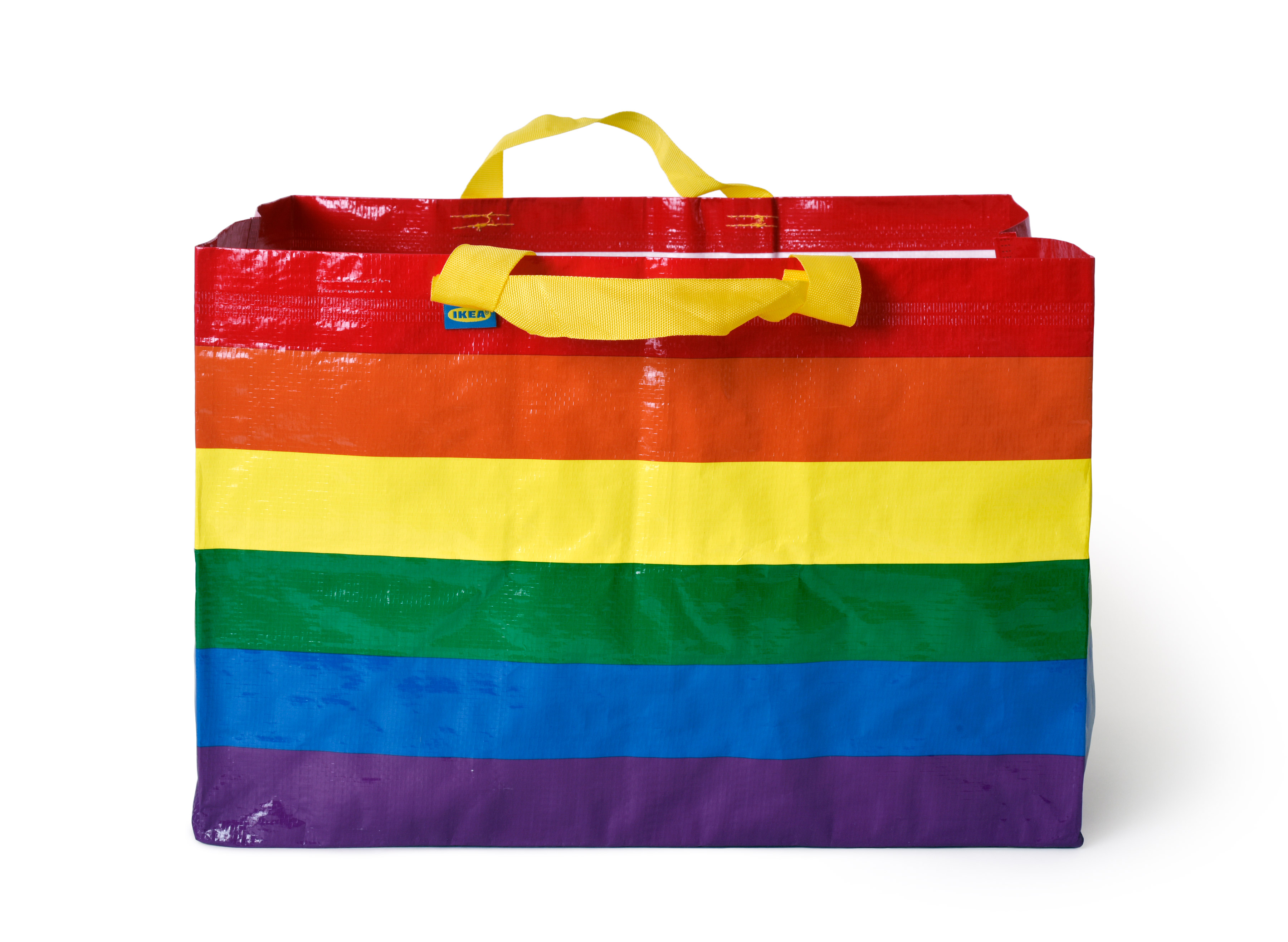
Almost everyone has seen one, many have at least one at home: the affordable, large and durable IKEA bag. The reinterpreted Pride edition “Storstomma”, shown here, was first introduced in 2019 under the name “Kvanting”: the familiar blue of one of the world’s most widely used bags gives way to the rainbow colours red, orange, yellow, green, blue and violet. Caught between solidarity and the commodification of Pride, this edition raises a question: what does it mean when a global corporation decides to present its perhaps most recognisable product in these colours?
The original blue “Frakta” bag came onto the market in the early 1990s. It was designed by siblings Knut and Marianne Hagberg and was intended to embody the values of democratic design: functional, sustainable and affordable for everyone. Through the interplay of these qualities, the blue “Frakta” has become one of the most celebrated design objects of the past 30 years. Millions of instantly recognisable blue bags are seen on streets around the world every day, serving as the perfect mobile advertisement for the world’s largest furniture retailer.
Since 2016, the “Frakta” has been reinterpreted by various designers and fashion houses, many of whom have remained faithful to the visual identity of the original. In 2019, IKEA launched the visually distinct “Kvanting”. Since its introduction, a significant portion of the proceeds from sales of the bag has gone to human rights organisations that fund programmes for LGBTQIA+ individuals around the world. IKEA presents itself as a longstanding advocate for the LGBTQIA+ community: the company holds membership in various Pride organisations, ranks highly in employer equality indices, and covers a portion of the costs of gender-affirming treatments through its healthcare plan.
Yet even IKEA cannot escape the inevitable paradox facing any globally operating corporation. In some countries, its support has been both open and pioneering — as in 1994, when it aired the first nationally broadcast television advertisement in the United States to openly portray a gay couple. Other markets have confronted a different reality: when Russia, then IKEA’s fifth-largest market, passed a “homosexual propaganda” law in 2013, the company removed a lesbian couple from the Russian edition of its catalogue. During the same period, women were digitally erased from the Saudi Arabian catalogue.
Can IKEA be accused of the all-too-familiar “pinkwashing“, namely the appropriation of a community’s identity through cheap, high-margin plastic products adorned with rainbow motifs, without structurally embedding the values of a movement? Or is a strong commitment to diversity, in those parts of the world where it is legally possible, the most one can reasonably expect from a global company?